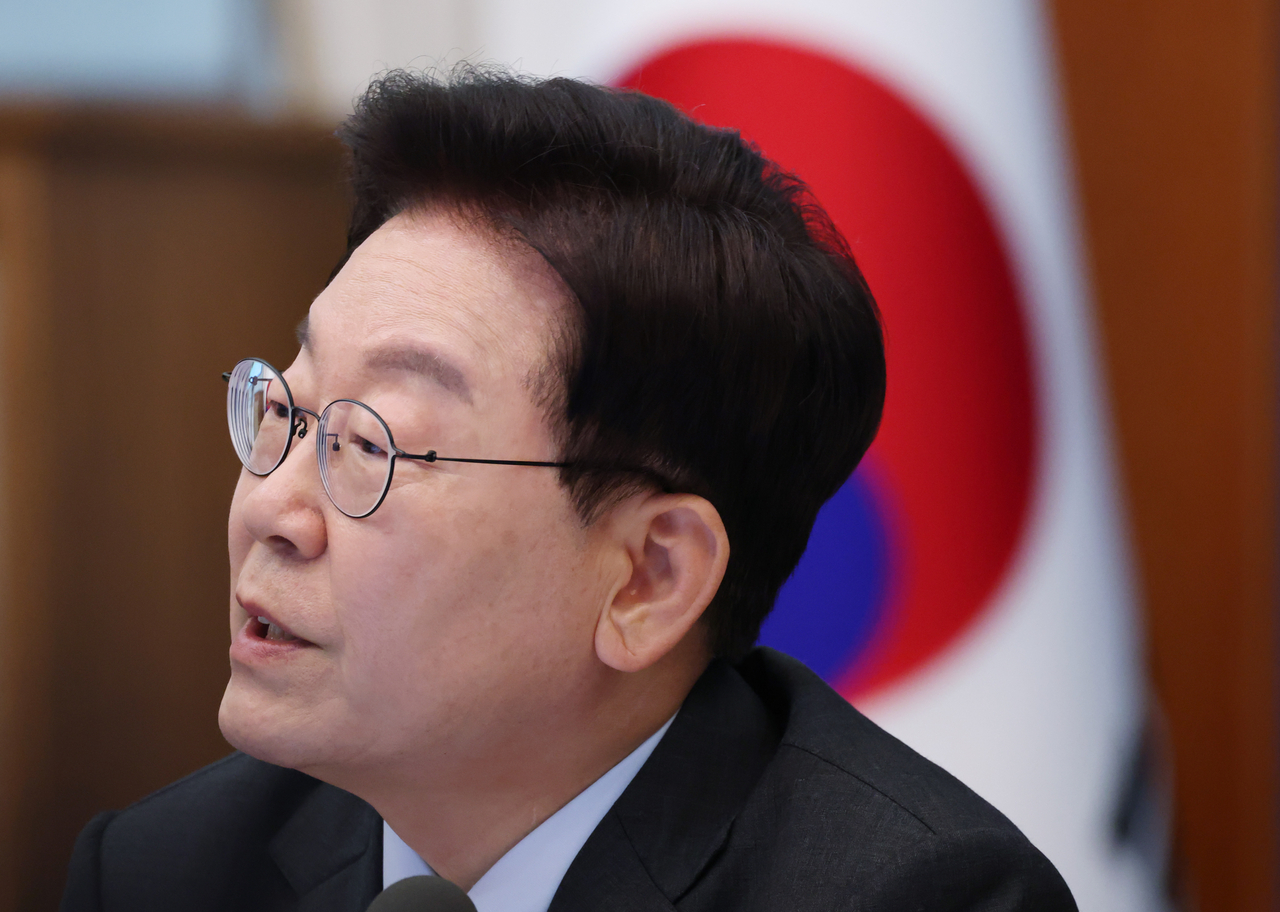
President Lee Jae Myung on Friday stressed that fairness must guide policies supporting multicultural families, calling for a review of preferential benefits while emphasizing the need to strengthen support that addresses their specific disadvantages.
It is the third consecutive day Lee has publicly raised concerns about preferential treatment for multicultural families, drawing criticism from political opponents who warn that questioning such benefits could fuel discrimination.
"Fairness is a core value of public administration, and fairness has nothing to do with the size or amount involved," Lee wrote on X, formerly Twitter. "Unfairness is not acceptable simply because the amount or quantity is small."
Lee underlined that "the purpose of supporting multicultural families is to address and correct disadvantages arising from their distinct circumstances and ensure they are treated on an equal footing with other families."
Against that backdrop, Lee explained that programs supporting cultural adaptation, bilingual education and community participation are essential to addressing vulnerabilities arising from the particular circumstances of multicultural families.
"Policies aimed at identifying and addressing other vulnerabilities should continue to be expanded and strengthened," he said.
Lee stressed that social and welfare policies, which impose costs on society as a whole and can leave some citizens relatively disadvantaged, require careful consideration to ensure that necessary support does not become excessive or unfair.
"If controversy arises over unfair preferential treatment that goes beyond restoring equality, the issue should be thoroughly reviewed, regardless of who raised the concerns," he said.
The president specifically questioned policies granting multicultural families priority access to public daycare centers and postpartum care facilities.
"The claim that multicultural families should be given priority or preferential treatment in social welfare policies because they are all disadvantaged needs to be examined to determine whether it is factually accurate," Lee said.
Lee noted that not all multicultural families face financial hardship, citing cases in which individuals are married to professionals from developed countries.
"If poverty is the issue, poor multicultural families should be treated the same as poor Korean families," he said.
Families below a certain income threshold, including multicultural families, qualify for a higher priority in postpartum support than other multicultural families.
Lee also cautioned against automatically categorizing all multicultural families as vulnerable, saying not all members of such families necessarily agree with that characterization.
"What matters more is that multicultural families are integrated into our society rather than treated as a separate group," he said. "Treating all multicultural families, without exception, as inherently vulnerable places the emphasis on distinguishing them from others."
The president further argued that removing potentially unfair elements from welfare policies could help protect multicultural families from hostility and far-right agitation.
"To protect multicultural families from far-right agitation intended to stir up hatred and hostility against them, we must also minimize opportunities for such attacks and agitation," he said.
"Regardless of the scale, elements that could be seen as unreasonable or unfair, or criticized as excessive or unjustified preferential treatment, could provide ammunition for far-right agitation and attacks against multicultural families," Lee added.
Lee said their minority status did not in itself justify all forms of support for multicultural families.
"Any social or welfare policy can be sustainable only when those who suffer disadvantages or losses can reasonably accept the extent of those burdens," Lee said, calling for broader and more in-depth discussion on the matter.
The president first raised the issue on X on Wednesday after sharing a post from an online community questioning why mothers from multicultural families received the same priority as mothers who are national merit beneficiaries in reservations for a public postpartum care center in Seoul.
On Thursday's X post, Lee said that policies aimed at preventing discrimination against multicultural families must continue. But Lee stressed that "policies must not go beyond their original purpose and result in excessive benefits amounting to preferential treatment or reverse discrimination against Korean families."
Lee's remarks have drawn criticism from various quarters, including the progressive Rebuilding Korea Party, which warned Thursday that his comments could deepen social divisions and fuel discrimination against multicultural families, calling on the president to offer a sincere apology to those who may have been hurt by his remarks.
"The president, who should be leading efforts to promote national unity, is embracing a biased perspective that views support for multicultural families as preferential treatment," the party said in a statement. "Politics that divide the people and pit them against one another can never serve as a driving force for governing the country."
dagyumji@heraldcorp.com